Tennessee F Endorsement Driver's License
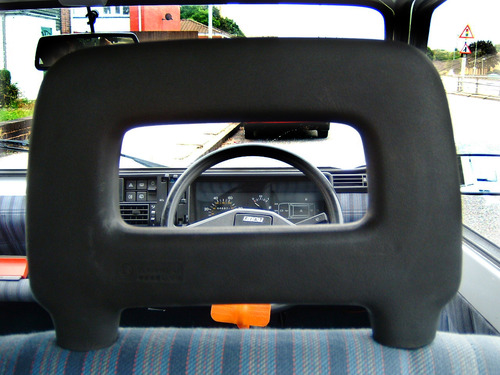
Properly adjusted seat head restraints in Tennessee (F Endorsement) should always be at a level even with the back of the head and are designed to prevent whiplash injuries in the event of a rear-end collision. Proper positioning is crucial for maximizing safety.
Properly adjusted seat head restraints:
Should always be at a level even with the back of the head
AND
are designed to prevent whiplash if hit from behind.
Key Terms
Properly adjusted seat head restraints:
Should always be at a level even with the back of the head
AND
are designed to prevent whiplash if hit from behind.
The driver should drive with both hands on the steering wheel approximately in the:
9 o'clock and 3 o'clock positions.
When adjusting the driver's seat for best driving posture, set the seat in an upright position where your body is about how far from the steering wheel?
10 to 12 inches
A child in a child passenger system (car seat) should:
Be facing the rear of the car seat (if less than 20 pounds and under 1 year old) AND should be facing forward (if the child is 1-3 years old and ov...
Children who are 4-8 years old and whose height is is under 4 feet, 9 inches:
Must be in a belt positioning booster seat system (child booster car seat) and wearing a seatbelt.
The lap belt should be worn:
1- OVER the the pelvis with the bottom edge toughing the tops of the thighs snugly.
2-The shoulder belt should be worn over the shoulder and acr...
Related Flashcard Decks
Study Tips
- Press F to enter focus mode for distraction-free studying
- Review cards regularly to improve retention
- Try to recall the answer before flipping the card
- Share this deck with friends to study together
| Term | Definition |
|---|---|
Properly adjusted seat head restraints: | Should always be at a level even with the back of the head |
The driver should drive with both hands on the steering wheel approximately in the: | 9 o'clock and 3 o'clock positions. |
When adjusting the driver's seat for best driving posture, set the seat in an upright position where your body is about how far from the steering wheel? | 10 to 12 inches |
A child in a child passenger system (car seat) should: | Be facing the rear of the car seat (if less than 20 pounds and under 1 year old) AND should be facing forward (if the child is 1-3 years old and over 20 pounds). |
Children who are 4-8 years old and whose height is is under 4 feet, 9 inches: | Must be in a belt positioning booster seat system (child booster car seat) and wearing a seatbelt. |
The lap belt should be worn: | 1- OVER the the pelvis with the bottom edge toughing the tops of the thighs snugly. |
Research has found that proper use of the lap/shoulder belts: | Reduces the risk of fatal injury to front seat passenger car occupants by 45% and the risk of moderate to critical injury by 50% (for occupant of light trucks 60-65%, respectively). |
AIRBAGS and CHILDREN! Children (ages 12 and under) are safer in the backseat of a vehicle because: | 1- Airbags can pose a severe risk of injury to children 12 and under in the event of a crash. Airbags and children "...simply do not MIX". |
The safest place for children (12 and under) to ride IN A VEHICLE EQUIPPED WITH AIR BAGS is: | The backseat. |
The "Yield" sign means: | Slow down and yield to traffic on main road when merging. |
What does a traffic signal with a "YELLOW LEFT ARROW" indicate to the driver? | Prepare to yield to oncoming traffic. |
The center of the roadway is marked with one SOLID yellow line and one BROKEN yellow line. If the BROKEN yellow line is one the RIGHT of the solid yellow line (your side), it means: | You are in a "passing zone" and it is safe to pass other vehicles if no oncoming traffic is present. |
Octagon Shape means: | STOP. |
Triangular Shape means: | Yield |
Round Shape means: | Railroad Ahead (some railroad signs have "Crossbucks"). |
Diamond Shape means: | Hazardous, unusual conditions ahead AND WARNING. |
Rectangular Shape means: | Special Laws, regulation or important information such as speed limits or HOV (High occupancy vehicle) signs. |
Work Area/ Construction signs | Generally diamond or rectangular shaped. Orange with black letters. |
Channeling Devices (usually orange) | 1)Barricades, vertical panels, drums, and cones. |
Signs having a WHITE BACKGROUND and a RED CIRCLE W/ LINE diagonally through them means: | "NO", according to what is behind the red symbol e.g., no bikes, no trucks, no U Turn, no left turn. |
Hitchhiking Signs | Although hitchhiking is legal in the state of Tennessee, it is not recommended. |
Guide signs for highways | U.S. Route signs consist of black numerals ( highway numbers) on a white shield surrounded by a black background and WITHOUT A BORDER. |
Interstate Route Markers | Blue & Red signs that indicate the route is part of a national system of interstate and defense highways. |
Guide Signs on Highways | Designed to give proper info for exits and lanes. |
Service Signs | The blue color of these signs directs motorists to service facilities. Word message signs will also be used to direct motorists to areas where service stations, restaurants and motels are available |
Handicapped/Accessible Symbol | Blue &White. Parking Spaces are reserved for vehicles bearing disabled veteran or handicapped license plates/ decal. |
MALFUNCTIONING TRAFFIC LIGHT: | Treat as a four-way stop. |
Edge and Lane Lines | Lines along the side of the road show you where the edge of the road is located. The right side of the road will ALWAYS HAVE A WHITE LINE. |
Two solid yellow lines | DO NOT CROSS/PASS |
Broken Yellow Lines | Indicates that you MAY cross/pass the lines if no oncoming traffic. |
One yellow line and one broken line | YOU MAY NOT PASS if the solid line is on your side. |
Statistics show that | Half of all vehicle crashes occur less then 25 miles away from home! |
Coasting prohibited | While traveling on a downgrade, NEVER coast with the transmission of the vehicle in neutral. Aldo, drivers of manual transmission vehicles MUST NOT COAST WITH THE CLUTCH DEPRESSED! DOING SO REDUCES THE DRIVER'S CONTROL OF THE VEHICLE. |
Use of Headlights | 1)Required night use: Car headlights must be turned on 30 minutes AFTER SUNSET until 30 minutes BEFORE SUNRISE. |
Dimming of headlights required: | When high beams are on, lower the beam when oncoming vehicles are within 500 feet ( approximately the distance of a city block) or when you are following another vehicle within 500 feet. |
Parking and Auxiliary Lights Fogs Lights: | Procedure when using; |
Daytime running lights | Automatically come on and stay on while the engine is running. MORE CLOSELY ASSOCIATED with newer vehicles. |
Slow Moving Vehicle | It is against the law to drive slower than the posted minimal speed under NORMAL DRIVING CONDITIONS. |
Funeral Processions | In Tennessee, it is a common and ACCEPTED practice for vehicles/ONCOMING TRAFFIC to pull to the side AS A SIGN OF RESPECT. |
The Basic Speed Rule Principles: | 1) You speed must be careful and prudent. |
Braking distance | The distance your car travels after you apply the brakes. |
Vehicles without antilock brakes | If car starts to skid, remove foot from brake and turn in the direction of the skid. this is recommended to avoid running off of the road. |
Two second rule | While driving on a highway, you must maintain a safe following distance. 2 to 4 seconds. |
Stopping Distances | Perception time (.50 seconds), Reaction time (about .66 seconds) , braking time (Varies by speed). |
Speed | Is a major contributing factor that causes fatal accidents in Tennessee. |
The speed limit on primary and secondary state and federal highways is: | 55 m.p.h. |
The maximum speed set by TENNESSEE law for interstate highways is: | 70 m.p.h. (..."This speed does not apply to ALL sections of the interstate highway system. It may be set as low as 55 m.p.h. in some larger urban areas where there is more traffic congestion"). |
Rural Interstate Speed Limit: | 70 m.p.h. is the speed posted on MOST of the rural sections of Tennessee interstate highway. |
Urban Interstate Limits | In the more congested urban or metropolitan areas of Tennessee interstates, the limit is typically 55 m.p.h. |
It is unlawful for any person to drive a vehicle less than: | 55 m.p.h. in the LEFT most lane of any Interstate highway, unless traffic congestion and flow prevent safe driving at such speed. |
On the interstates, the minimum speed limit in the RIGHT lane(s) is: | 45 m.p.h., and under normal driving conditions, all vehicles must travel at least this fast so they are not a hazard to other drivers. |
Exceeding the school zone speed limit is by law considered to be: | Reckless driving! The penalty includes an automatic 6 points added to your driving record! |
For violations of the speed limit posted in active work zones: | Tennessee law mandates A MINIMUM FINE OF $250 DOLLARS AND UP TO A MAXIMUM FINE OF $500 DOLLARS. |
By law, all automobiles must have two separate methods of applying brakes: | Regular brakes (foot brake) and a parking or emergency brake (sometimes referred to as a "hand brake"). |
Covering the brake means: | "Covering the brake" means the driver's foot needs to hover over the brake or between the brake and gas pedals for quicker response time |
Riding the brake means: | "Riding the brake" is keeping your foot resting or slightly pressed down on the brake. This adds much wear and tear on the vehicle's brake system, and also gives other drivers the false impression that a stop is imminent. Riding the brake is NOT a safe practice. |
Tennessee Code defines "stop" as: | "...A complete cessation of movement". |
When you approach a railroad crossing and a train is coming, you must stop between: | 15 and 50 feet from the railroad tracks! |
Trains are required to signal a horn when they are approximately: | 1,500 feet from passing through a railroad crossing. |
Tennessee law requires certain vehicles to stop at all railroad grade/highway crossings, whether or not any signs or signals are activated when the vehicle approaches the crossing: | • Church or school buses, regardless of whether such buses are carrying any passengers at the time of crossing; |
The school bus stop law | Any driver meeting a school bus or church bus on which the red stop warning signal lights are flashing should reduce his speed and bring the vehicle to a complete stop while the bus stop signal arm is extended. |
Overtaking a school bus | Any driver approaching a school bus or church bus from the rear shall not pass the bus when red stop warning signal lights are flashing. The vehicle must come to a complete stop when the bus is stopped. |
School bus warning lights | It is illegal to pass a school bus that has stopped to load or unload students. |
Making a LEFT turn | 1- Well ahead of the turn, look for any following cars and move close to center line. Signal for moving over. |
Making a RIGHT turn. | 1- Far before the corner, move over to the right side. |
Roundabout | An intersection control device with traffic circulating around a central island. Always travel around a roundabout to the right, in a counter-clockwise direction. |
U Turns | A U-turn is a turn within the road, made in one smooth u-shaped motion, so as to end up with your vehicle traveling in the opposite/reverse direction as before the turn |
You may NOT make a U-turn | You may NOT make a U-turn where signs prohibit it, on curves, or near the crest of a hill where visibility is limited. |